Switches for Central Body Control
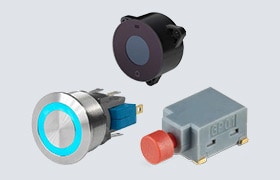
 Switches are devices
that provide manual input or control for equipment, a device, or a process. Switches serve many
purposes, provide immediate emergency control, local control, or indication; and are available
in many formats, shapes, sizes, and colors. Switches and buttons are important in everyday use
from light switches or buttons to automatic switches that shut off a motor when an attached gate
has fully shut.
Switches are devices
that provide manual input or control for equipment, a device, or a process. Switches serve many
purposes, provide immediate emergency control, local control, or indication; and are available
in many formats, shapes, sizes, and colors. Switches and buttons are important in everyday use
from light switches or buttons to automatic switches that shut off a motor when an attached gate
has fully shut.
Hall Effect Sensors for Central Body Control
 Hall Effect
sensors are magnetically biased transducers that vary output voltage or current in response to
changes in a magnetic field. Hall Effect sensors can be designed to sense rotary movement of a
motor shaft. The rotation of the motor shaft changes the IC's position with respect to the
magnets, and thus detects the change in flux density. The output of the IC is converted to a
linear output over 90 degrees of shaft travel. The Hall Effect sensor gets its name from Edwin
Hall, who, in 1879 discovered that a voltage difference can be produced across an electrical
conductor where the magnetic field is perpendicular to the direction of current flow.
Hall Effect
sensors are magnetically biased transducers that vary output voltage or current in response to
changes in a magnetic field. Hall Effect sensors can be designed to sense rotary movement of a
motor shaft. The rotation of the motor shaft changes the IC's position with respect to the
magnets, and thus detects the change in flux density. The output of the IC is converted to a
linear output over 90 degrees of shaft travel. The Hall Effect sensor gets its name from Edwin
Hall, who, in 1879 discovered that a voltage difference can be produced across an electrical
conductor where the magnetic field is perpendicular to the direction of current flow.
Common Mode Chokes for Central Body Control
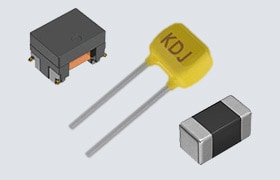
 A choke is an inductor
used for the purpose of protecting a circuit from higher frequency noise. A common-mode choke
consists of two coils (inductors) that are coupled and share a single magnetic core. Often used
to block electromagnetic interference (EMI) caused by radio waves or power circuitry, they
operate by rejecting any common-mode currents flowing to or from the load.
A choke is an inductor
used for the purpose of protecting a circuit from higher frequency noise. A common-mode choke
consists of two coils (inductors) that are coupled and share a single magnetic core. Often used
to block electromagnetic interference (EMI) caused by radio waves or power circuitry, they
operate by rejecting any common-mode currents flowing to or from the load.
Switch Monitors for Central Body Control
 Switch monitors
serve as an interface between a low voltage microcontroller and one or more electrical switches.
In addition to protecting the microcontroller from higher voltage levels and transients, they
can also free up a large number of the MCU???s GPIO (general purpose input/output) pins that
would otherwise be required to monitor each switch. The switch monitor provides the monitoring
pins while interfacing with the MCU via a serial bus such as SPI or I2C. Some monitor ICs will
provide additional features, such as an interrupt pin or an analog multiplexor output.
Switch monitors
serve as an interface between a low voltage microcontroller and one or more electrical switches.
In addition to protecting the microcontroller from higher voltage levels and transients, they
can also free up a large number of the MCU???s GPIO (general purpose input/output) pins that
would otherwise be required to monitor each switch. The switch monitor provides the monitoring
pins while interfacing with the MCU via a serial bus such as SPI or I2C. Some monitor ICs will
provide additional features, such as an interrupt pin or an analog multiplexor output.
LIN Transceivers for Central Body Control
 LIN (Local
Interconnect Network) is a vehicle network protocol for communication between automotive
components. Inexpensive and relatively simple to implement, a LIN network uses a broadcast
topology with a single master ??? typically an MCU ??? and up to 12 slave devices. As such, it
is often used for networking small subsystems, with the master device connecting the subsystem
to the vehicle???s main bus line, such as a CAN bus.
LIN (Local
Interconnect Network) is a vehicle network protocol for communication between automotive
components. Inexpensive and relatively simple to implement, a LIN network uses a broadcast
topology with a single master ??? typically an MCU ??? and up to 12 slave devices. As such, it
is often used for networking small subsystems, with the master device connecting the subsystem
to the vehicle???s main bus line, such as a CAN bus.
CAN Transceivers for Central Body Control
 CAN is an acronym for
Controller Area Network and refers to a fault-tolerant communications protocol that is flexible
for system design, supports multiple network topologies, and has become a de facto standard for
high integrity serial communications in industrial and automotive embedded applications. In a
CAN network, several short pieces of data like a motor???s run status, temperature, or RPM is
broadcast over the entire network at up to 1 megabit per second (Mbps.)
CAN is an acronym for
Controller Area Network and refers to a fault-tolerant communications protocol that is flexible
for system design, supports multiple network topologies, and has become a de facto standard for
high integrity serial communications in industrial and automotive embedded applications. In a
CAN network, several short pieces of data like a motor???s run status, temperature, or RPM is
broadcast over the entire network at up to 1 megabit per second (Mbps.)