








Analog Devices Inc. SHARC® Processors
Analog Devices SHARC® Processors dominate the floating-point DSP market with exceptional core and memory performance and outstanding I/O throughput. These processors are based on a Super Harvard Architecture that balances exceptional core and memory performance with outstanding I/O throughput capabilities. The SHARC processors integrate large memory arrays and application-specific peripherals designed to simplify product development and reduce time to market. These processors are used in automotive, process control, and motor control applications.
Features
- 32/40-Bit IEEE floating-point math
- 32-bit Fixed-point multipliers with 64-bit product & 80-bit accumulation
- No arithmetic pipeline
- Six nested levels of zero-overhead looping in hardware
- Rich, algebraic assembly language syntax
- Instruction set supports conditional arithmetic, bit manipulation, divide & square root, bit field deposit and extract
- DMA allows zero-overhead background transfers at full clock rate without processor intervention
Applications
- Automotive
- Motor and power control
- Process control
- Security and surveillance
- Test and measurement
Videos
SHARC+ Processors
Analog Devices SHARC+ Processors provide dual-enhanced high-performance floating point cores. These processors offer low system power across automotive temperature range. The SHARC+ processors have a large on-chip L2 SRAM with ECC protection upto 1MB.
Additional Resources
Datasheet
Features
- Up to 450MHz per SHARC+ core
- Up to 3Mb L1 SRAM memory per core with parity (optional ability to configure as cache)
- 32-bit, 40-bit, and 64-bit floating point support
- 32-bit fixed support
- Powerful DMA system
- On-chip memory protection
Additional Resources
Functional Block Diagram

Planning For Success In Real-Time Audio Processing
A standalone audio DSP optimized for low latency processing is likely to lead to increased robustness, decreased development time, and optimal scalability to accommodate future system needs and performance tiers.
Associated DSPs
Analog Devices Inc. ADSP-2183x/-SC83x High-Performance SHARC®-FX DSPs
Features a SHARCFX core that utilizes a SIMD vector floating-point architecture.

Analog Devices Inc. ADSP-21591/ADSP-21593 SHARC+ Dual-Core DSPs
Members of the SIMD SHARC family of DSPs that feature ADI Super Harvard architecture.

Analog Devices Inc. ADSP-2156x SHARC+ Single-Core High Performance DSP
Based on the SHARC+ single core of the SIMD SHARC family of DSPs with Super Harvard Architecture.

Analog Devices Inc. ADSP-SC59x/ADSP-2159x SHARC® Processors
Developed to supply immersive audio experience in automotive and consumer/pro-audio applications.

Analog Devices Inc. ADSP1802 SHARC® Processors
32-bit/40-bit floating point processors optimized for high-performance audio applications.
Development Tools
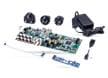
Analog Devices Inc. ADZS-SC58x Evaluation Systems
Evaluation system designed to aid in the development and testing of the ADSP-SC58x family of SHARC® processors.

Analog Devices Inc. ADSPSC835W-EV-SOM System-on-Module (SOM) Board
Allows for rapid prototyping of designs featuring the ADSP-SC83x/2183x SHARC-FX audio processors.